Research question
How do we turn labeled measurements into a reusable study?
A state detector answers an observation-level question: which state applies at each sample? Many downstream questions concern larger structures—one bounded occurrence, its duration and measurements, its completeness, and its relationship to neighboring occurrences.
FeatureGraph performs that structural and analytical work while respecting scientific authority. The source method determines the labels; FeatureGraph groups and measures them without smoothing, merging, splitting, relabeling, or reinterpreting the sequence.
Representation workflow
Understand the data, specify the analysis, validate, and reuse.
| Stage | Responsibility |
|---|---|
| Scientific detector | Assign a state or event label to each observation. |
| Researcher specification | Declare how consecutive labels should be grouped, measured, compared, and checked. |
| FeatureGraph analysis | Run those steps deterministically and retain the source measurements behind every result. |
| Structural validation | Reconstruct the source labels and verify coverage, interval starts and ends, and sequence order. |
| Scientific interpretation | Decide what the results mean and whether they support a conclusion. |
Explicit limits
Deterministic, repeatable data analysis.
FeatureGraph is deterministic. It does not decide what the latent states mean, improve the source detector, or determine whether a scientific event is meaningful. Those decisions remain with the detector, researcher, or domain specialist.
What the framework does provide is equally important: inspectable rules for grouping measurements, exact interval starts and ends, consistent handling of incomplete data, declared calculations, and result tables that expose exactly how every value was produced.
CLaP interoperability study
Lossless materialization of an external state sequence.
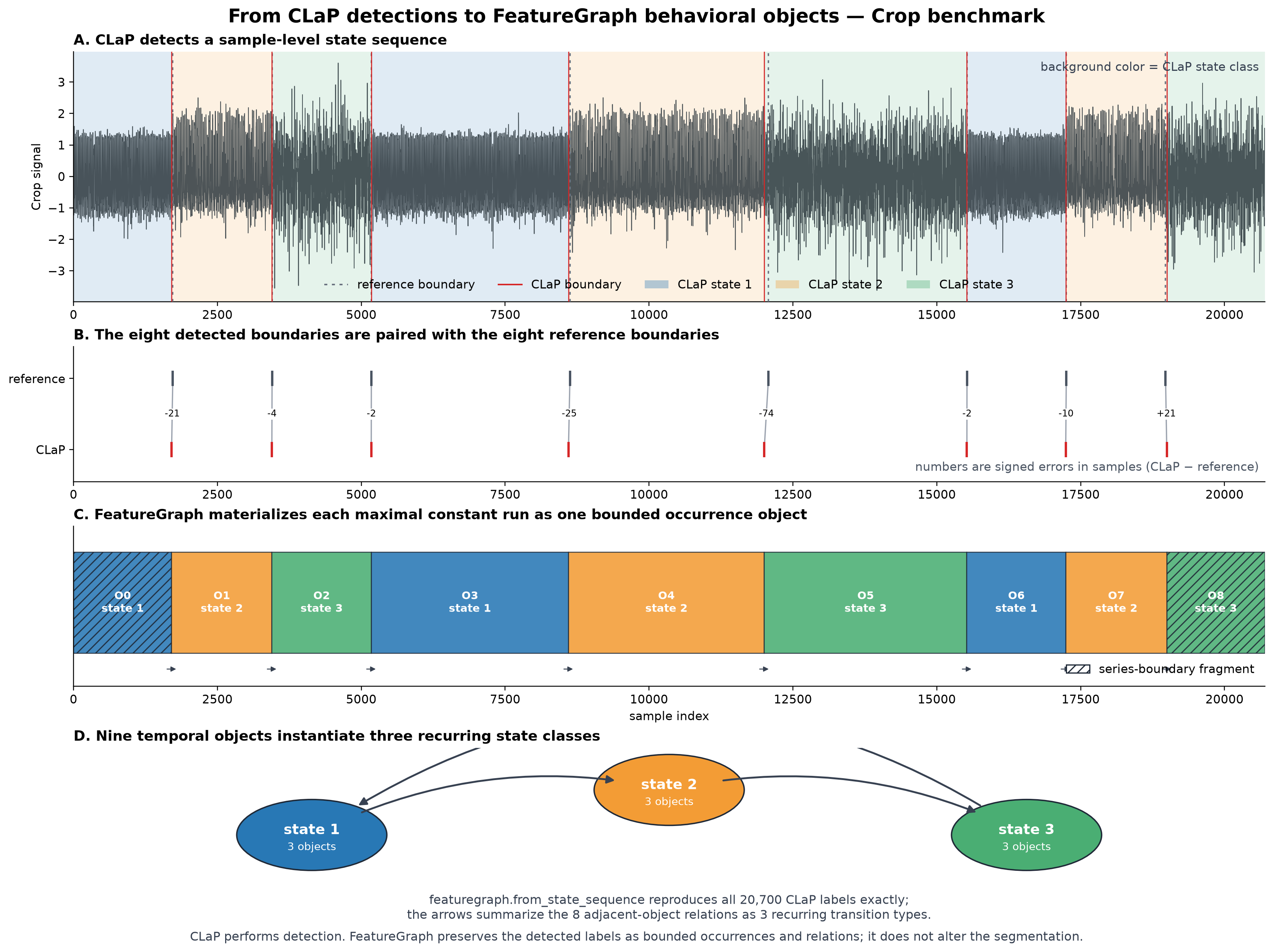
The maintained ClaSPy implementation of CLaP detected three
recurring states and eight change points in the 20,700-sample Crop
benchmark. The public
featuregraph.from_state_sequence API consumed those
unchanged labels and produced nine
FeatureObject occurrences, including seven complete
internal objects and two boundary-truncated fragments.
Eight precedes relations connect adjacent
occurrences. Repeating each object's state label over its sample
count reconstructs all 20,700 CLaP labels exactly. All eleven
declared study validations and twelve focused package tests
passed.
| Layer | Result | Authority |
|---|---|---|
| State detection | 3 classes; 8 detected change points | CLaP |
| Occurrence representation | 9 bounded objects; 2 boundary fragments | FeatureGraph |
| Temporal relations | 8 adjacent-object relations; 3 recurring transition types | FeatureGraph |
| Label reconstruction | 20,700 of 20,700 labels reproduced | FeatureGraph validation |
| Reference agreement | ARI 0.977; AMI 0.959 | CLaP versus benchmark |
BIDMC respiration study
Preservation and transfer results.
BIDMC was chosen because it provides 53 public, eight-minute records at a fixed 125 Hz sampling rate, visible repeated waveform structure, and two independent manual annotation series. The researcher did not begin with respiration-domain expertise, so this is a representation study—not clinical validation and not a claim about calibrated airflow or volume.
The experiment began with an independent reference analysis of BIDMC subject 1. The researcher then encoded a deterministic candidate-breath construction in the public alpha using a 45-sample difference lag, a fixed threshold, a seven-sample state-gap rule, explicit peak boundaries, and incomplete-object exclusion.
| Evaluation | FeatureGraph | Reference analysis | Interpretation |
|---|---|---|---|
| Subject 1 complete objects | 174 | 169 | All 169 baseline objects matched; 5 FeatureGraph-only candidates. |
| Subject 1 estimated rate | 21.9/min | 21.1/min | Different endpoint coverage; close descriptive rates. |
| Subject 1 peak agreement | Median absolute error: 10 samples | Strong object-level boundary agreement. | |
| All 53 subjects, beta envelope/plateau rule | 8,133 complete objects | 7,168 objects | 7,086 matched; 1,047 FeatureGraph-only; 82 baseline-only. |
| Detector-discordant handoff | 1,047 bounded episodes | Two annotation series | 680 excluded by both annotators; 367 not excluded by both; clinical interpretation remains unassigned. |
What agreed
| Matched-object measure | FeatureGraph | Reference path | Interpretation |
|---|---|---|---|
| Mean period | 2.802 s | 2.821 s | Median absolute error 0.040 s. |
| Mean full excursion | 0.896 | 0.903 | Median absolute error 0.00489. |
| Mean temporal symmetry | 0.596 | 0.844 | Boundary semantics do not agree. |
On subject 1, cycle count, period, full excursion, and object boundaries agreed closely. Earlier amplitude disagreement was a measurement-contract issue: the raw-data run used full peak-to-trough height while FeatureGraph's radius amplitude was half that value. The harmonized comparison uses full excursion.
What did not agree
Temporal symmetry remains sensitive to different trough-boundary semantics and should not be treated as equivalent. Exact plateau intervals substantially improved transfer—especially for subjects 35, 38, and 39—without changing the detected-event count. The remaining 1,047 FeatureGraph-only objects are localized and retained as detector-discordant episodes rather than classified as false detections or clinical abnormalities.
Methodological limitation
The frozen comparator uses SciPy peak finding, while the beta FeatureGraph construction uses its own grouped rolling envelope, directional states, transition events, and interval-valued extrema. SciPy is not a core FeatureGraph dependency; it remains optional only for reproducing the comparator. The comparison supports deterministic native construction and auditable disagreement, not universal detector equivalence.
Tennessee Eastman transfer study
Frozen transfer beyond the development run.
The TEP study freezes the reactor-pressure construction selected on Fault 2 run 10 and applies it unchanged to held-out Fault 2 runs, normal-operation windows, and contrasting fault classes. It supports a repeatable abnormal-pressure representation, not a Fault 2 classifier.
Representation richness
The same breath can support a dependent accumulation object.
Within each candidate oscillation, accumulation integrates signal contribution relative to an explicit baseline. In a respiration waveform this is best interpreted as waveform area above that baseline—not literal inhaled volume unless the sensor has been calibrated to support that physical interpretation.
The dependent object records total area, rates, timing, centroid, and contribution before and after the peak while retaining its parent wave identity and completeness. This demonstrates that the representation can preserve compositional structure beyond a flat list of engineered features.
Next phase
Test the same object contract across detectors and domains.
Across BIDMC, TEP, and CLaP, the current studies establish native
construction, frozen transfer, and external-detector
interoperability. The frozen BIDMC beta paper remains the released
record, while the current workflow studies are documented on
main.
The next research phase tests whether the same observation–event–object separation and stable object schema can support additional maintained scientific methods without taking over their domain-specific decisions.